
AI Workflow Automation: A Reliable Operating Model
Back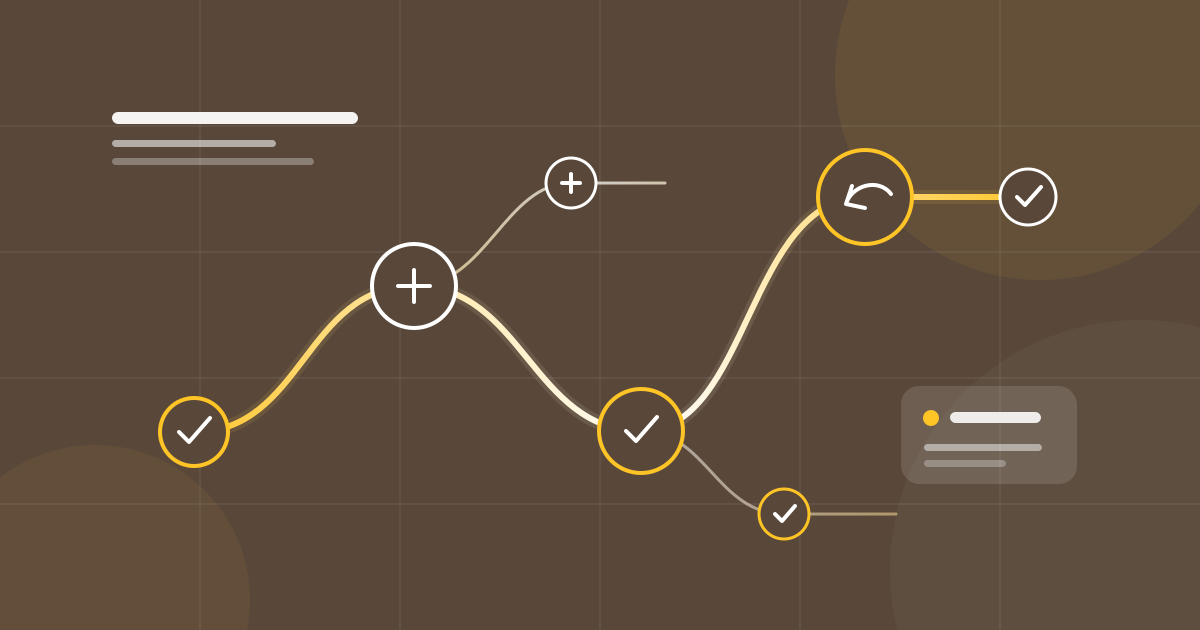
Reliable AI workflow automation does not begin with the most autonomous agent. It begins by turning a bounded business process into observable steps, with approved data, limited permissions, validation, fallbacks and human approval where consequences become significant. That operating model turns a compelling prototype into a workflow a team can own, measure and improve.
What AI workflow automation actually includes
Traditional automation follows predictable rules. A complete form creates a record; an approved invoice moves to the next queue. AI becomes useful when inputs are unstructured or a decision cannot be expressed entirely as fixed logic. A model might classify an email, extract fields from a document, draft a response or recommend the next action.
The model is still only one component. A production workflow also includes data sources, business rules, identity and access controls, integrations, validation, logging and operational ownership. Evaluating only model quality misses the surrounding system that determines whether work is dependable in practice.
Why orchestration matters more than maximum autonomy
Recent research and engineering reports point toward the value of system design, although their findings should not be treated as universal proof. One experiment on language-model harnesses examines how complex tasks can be reduced to smaller, more familiar calls. An engineering report on coordinated agents describes separate planning and execution roles, shared design records and independent review. The practical lesson is broader than either experiment: coordination, context and control deserve at least as much attention as the choice of model.
A reliable AI workflow automation operating model
1. Choose a bounded process with a clear outcome
A strong first use case is frequent, visibly time-consuming and owned by a real team. An error should be detectable and preferably reversible. Triage of inbound requests, preparation of internal documents and response drafting can fit. Hiring decisions, final payment approvals and processes without an accountable owner usually do not make good first pilots.
Define “done” before selecting tools. What event starts the workflow? What output is required? Who uses it? Which errors are tolerable? When should the system stop or escalate? These questions make the pilot testable and prevent an open-ended automation project from expanding without a decision boundary.
2. Break the workflow into observable steps
Consider an incoming customer request. The system first captures the message. A model classifies topic and urgency. A rules-based step retrieves only approved context. The model drafts a reply. Deterministic checks then verify required fields, sensitive information and permitted actions. A person approves the result, or low-confidence cases move to an escalation queue.
This decomposition creates visible hand-offs. A failed step can be repeated without rerunning the entire process. It also becomes possible to distinguish a data problem from a model problem, a business-rule problem or an integration failure. That diagnosis is essential when the workflow starts handling real volume.
3. Assign permissions and approvals by consequence
Give the workflow access only to the data and tools required for its specific job. Reading, drafting, editing, sending and deleting are different permissions. External communication, payments, contract changes, account access and deletion need explicit approval or narrowly defined rules with a reliable audit trail.
This is not just conservative product design. The OWASP Top 10 for LLM applications identifies risks including prompt injection, improper output handling and excessive agency. In operational terms, assume inputs can be hostile, validate outputs before another system acts on them and limit the blast radius of a wrong decision.
4. Design validation and fallbacks as product features
A prompt is not a quality-control layer. Validate structured output against a schema, required fields against business rules and cited information against the approved knowledge base. Define a route for uncertain cases: retry with cleaned context, use a simpler deterministic path, ask for human review or stop without creating an external side effect.
Model and provider dependencies also need a plan. A recent case study on dynamic LLM routing describes an internal system that considers reliability, latency, cost and fallbacks together. Its reported results apply to that implementation, not every business. The useful design principle is to set use-case-specific thresholds and route according to observed operating data rather than a permanent model preference.
5. Measure the business process, not isolated answers
A good model response can exist inside a poor workflow. Measure end to end: correctly completed cases, human correction rate, escalation rate, cycle time, cost per case and failures by cause. Add qualitative review of representative samples. The goal is to learn whether automation removes work or simply creates a new review queue.
Governance should scale with risk
The architecture does not replace legal or domain review. NIST says its AI Risk Management Framework is intended to help organizations incorporate trustworthiness considerations into the design, development, use and evaluation of AI systems. Its govern, map, measure and manage structure is useful because it connects technical testing to ownership and ongoing risk decisions.
For teams operating in Europe, the European Commission describes the AI Act as a risk-based framework. Its discussion of high-risk systems highlights risk management, logging, documentation, human oversight, robustness, cybersecurity and accuracy. Not every internal automation is high-risk, but these remain useful design questions whenever a workflow can materially affect people or business operations.
Document the purpose, data sources, vendors, retention, owners and approval rules. Review privacy, confidentiality, sector obligations and employment implications for the actual use case. Bring legal and domain specialists into sensitive or regulated workflows early rather than treating compliance as a launch checklist.
A seven-point pilot checklist
• Name one bounded process, an accountable team and a measurable outcome.
• Document inputs, outputs and approved data sources.
• Make each step observable and independently testable.
• Apply least privilege and approval gates to consequential actions.
• Define validation, escalation, retry and safe-stop behavior.
• Test normal, rare, malformed and adversarial inputs.
• Monitor quality, corrections, time, cost and failure causes.
The practical next step
Do not start by asking which agent can take over everything. Choose one bounded flow, record today’s baseline and map its data, decisions, risks and hand-offs. The result should be small enough to control and meaningful enough to teach the team something. If you need to develop the architecture, integrations and operating model together, sophne can help move from a selected use case to a reliable AI workflow.
FAQ